

Great Wall excavation yields key archaeological discoveries in Beijing
连世界 12-03
Archaeologists in Beijing on Monday announced important discoveries in the recent excavation of the Jiankou section of the Great Wall, where a large cannon has been unearthed.
The excavation focused on three beacon towers and their connecting walls, revealing numerous artifacts this year, including weapons, architectural parts, and objects of daily use, according to Shang Heng, an associate research fellow at the Beijing Institute of Archaeology, at a press conference on the latest archaeological findings in 2025.
Among these artifacts was a large cannon cast in the late Ming Dynasty (1368-1644), measuring 89.2 centimeters in length and weighing 112.1 kilograms -- the largest artillery piece ever found in this section of the Great Wall.
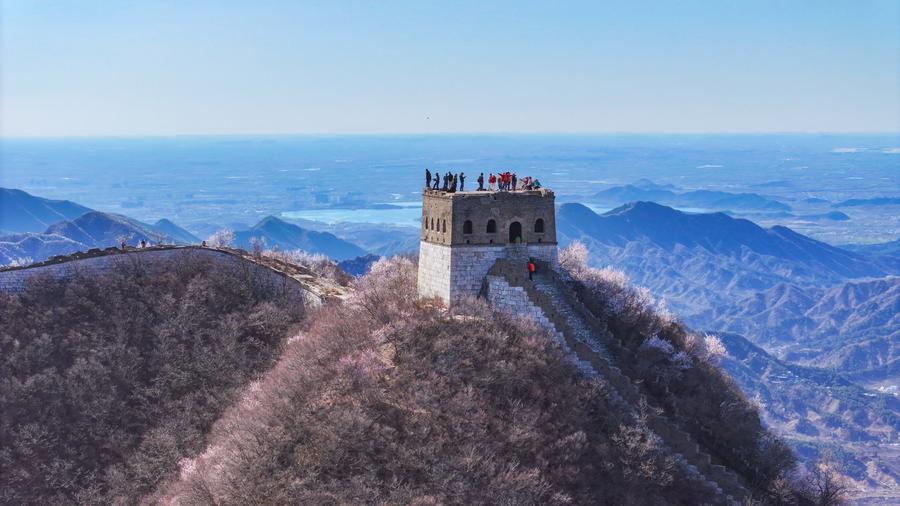 An aerial drone photo taken on April 5, 2025 shows people visiting the Jiankou section of the Great Wall in Beijing, capital of China.
Shang said that the well-preserved inscriptions on the cannon provide crucial new evidence for research on firearms manufacturing and historical military technology exchange during the period.
Also announced was the research findings of turquoise artifacts at the Xingong site, which is a rare settlement dating back to the Xia (2070 B.C.-1600 B.C.) and Shang (1600 B.C.-1046 B.C.) period in Beijing's urban area.
The site, featuring burial grounds, moats and residential remains, has revealed 28 turquoise artifacts. Analysis indicates the turquoise likely originated from mines at the junction of the provinces of Hubei, Henan and Shaanxi, providing key evidence of early cultural exchange in northern China, according to Yang Ju, a research fellow at the institute.
(Xinhua)
责任编辑:王晓莹

热门评论 我要评论 微信扫码
移动端评论
暂无评论